The short answer: If you live in a city that runs its own landfill, dropping off your own household trash is often free or very cheap — many Texas cities let residents dump at no charge if you show proof of residency. Everyone else usually pays a “tipping fee” charged by weight (commonly around $30–$55 per ton in 2026) or a flat “minimum load” fee of roughly $15–$40 for a small car or trailer load. The exact number depends entirely on which facility you use, so always check the price on the listing before you drive out.
What “dump fees” actually means in Texas
“How much does it cost to dump trash?” sounds like it should have one answer. It doesn’t — and that’s exactly why so many people end up surprised at the gate. In Texas, what you pay is set by the individual landfill, transfer station, or recycling/drop-off center you use, and the pricing is built two different ways:
- By weight (tipping fee): The facility weighs your vehicle in and out, and charges per ton. This is normal at large municipal landfills.
- By load (flat/minimum fee): Smaller transfer stations and county sites often skip the scale for small loads and charge a flat minimum — e.g. a set price for “a car,” “a pickup,” or “a small trailer.”
The honest truth most directories won’t tell you: a lot of facilities don’t publish their fees online at all. When that happens, the only reliable number is the one you get by calling. On every listing where a facility hasn’t posted its price, we mark it “Call to confirm” rather than guess — because a made-up fee is worse than no fee. You can read more about how we handle that in our Data Promise.
Free dumping for residents (the option people miss)
Here’s the biggest money-saver in the state: many Texas cities own a landfill or transfer station and let their own residents drop off household waste for free, or close to it. Dallas is the classic example — there’s no charge for Dallas residents who haul their own household waste in a passenger car, pickup, or trailer under 15 feet, as long as they show a valid Texas driver’s license with a Dallas address or a current Dallas water bill. The catch is almost always the same three things:
- Proof of residency required — a driver’s license or utility bill showing your address in that city or county.
- Household waste only — “free” usually means waste from your own home, not from a job site or a business.
- Vehicle size limits — the free rate often applies to cars, pickups, and small trailers; bigger loads get charged commercial rates.
If you live just outside the city limits, you’ll usually pay the commercial rate even at a “city” landfill, so it’s worth checking your county’s own sites too.
Typical Texas dump prices in 2026
These are realistic ranges to set your expectations — not a quote for any one site. The only number that counts is the one published by the facility you’ll actually use.
| What you’re dropping off | Typical 2026 range | How it’s charged |
|---|---|---|
| Resident household trash (your own city) | Free – $15 | Often free with proof of residency |
| Small car / SUV load | $15 – $30 | Flat minimum fee |
| Pickup or small trailer load | $25 – $55 | Flat fee or by weight |
| General waste by weight | ~$30 – $55 per ton | Tipping fee (scale) |
| Tires, mattresses, appliances | Extra per-item fee | Surcharge on top |
| Uncovered/loose load | $20 – $40 penalty | Added if not tarped |
The hidden fees that catch people out
The “uncovered load” penalty
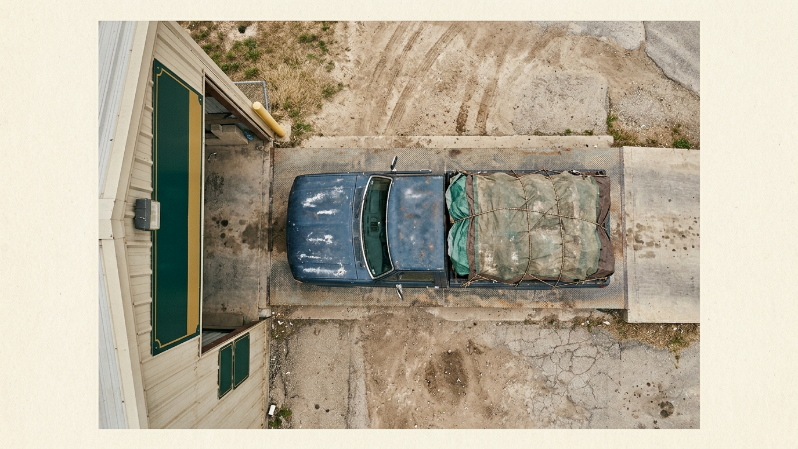
A lot of Texas landfills add a surcharge — often around $40 — if your trailer or truck bed isn’t covered or tarped, because loose trash blows onto the road on the way in. Throw a tarp and a couple of bungee cords in before you leave and you’ll skip it entirely.
Special-item surcharges
Tires, mattresses, refrigerators and other appliances with refrigerant, and electronics are frequently charged on top of the base fee, or banned from the regular trash entirely. If your load includes any of those, check the specific rules first — our guides on mattress disposal and TV & electronics disposal in Texas walk through the cheaper routes.
Cash vs. card
Plenty of smaller and rural transfer stations are cash-only, and some add a small fee for card payments. It’s the single most common reason people get turned away at the gate — bring cash to be safe.
How to find the real price near you
Every facility in our Texas directory shows its published fee where one exists, plus the date we last verified it and a link to the source — so you can check our work yourself. Search your city or county, open the nearest landfill or transfer station, and you’ll see exactly what they charge (or a clear “Call to confirm” with the phone number if they don’t post it).
Driving to a big city soon? Start with our deep-dive on McCommas Bluff Landfill in Dallas — the state’s busiest municipal landfill — for a worked example of how resident-free dumping and commercial rates fit together.
One rule before you drive: confirm the price and the hours on the listing the day you go. Fees change every fiscal year, and a wasted trip costs more than a phone call.